Chinese Ministry Blessings and Challenges
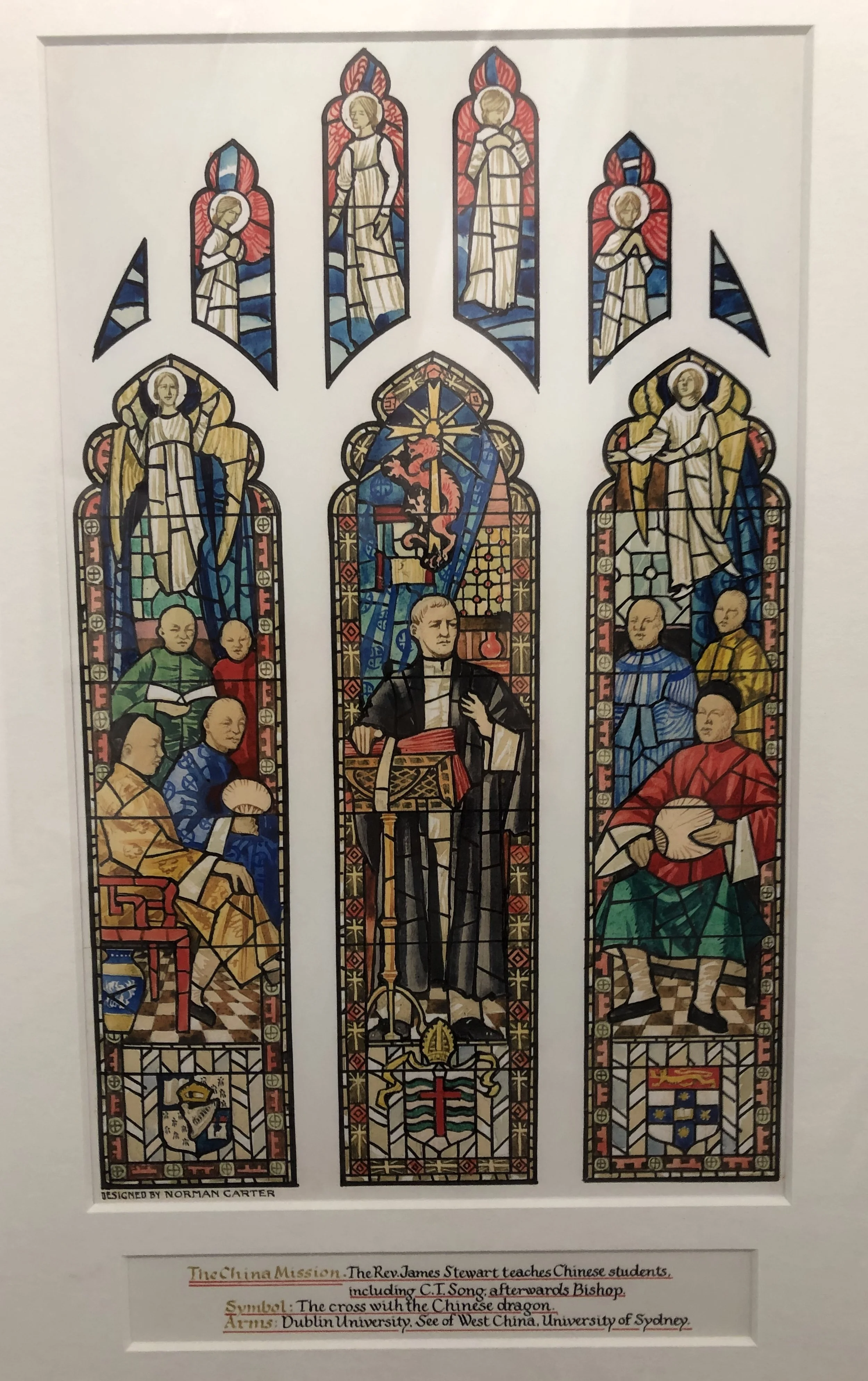
The China Mission, image of Clerestory window, St Andrew’s Cathedral
Cathedral Newsletter – 3 September 2026
Friends in Christ, last Tuesday I accompanied our Assistant Minister, Serena Cheung, to the Sydney Anglican Chinese Ministry Conference at St Anne’s Ryde (which turns 200 this year!). It was excellent.
As one of our own stained glass windows shows (high up above our central seating on the north side), mission to and ministry among Chinese people has been occurring since early in modern Australian history, notably since the 1850s gold rushes in NSW and Victoria. The window depicts the Reverend James Stewart teaching various Chinese students including C.T. Song, who later became the first Chinese Bishop of Western Szechwan (Sichuan).
I learned that there are now about 1.2 million people of Chinese ancestry in Australia, with 550,000 of them in Sydney. That’s about 1/9 Sydneysiders of Chinese origin. Mandarin is the second-most spoken language at home other than English, and Cantonese fourth-most spoken. Currently another 15,000 Chinese-born migrant are arriving every year, although these days many of them suffer ‘visa anxiety due to stricter visa, residency and citizenship requirements.
Happily there are now over a 100 Chinese Christian congregations in Sydney including in 28 Anglican parishes. Some of the Chinese Anglican ministers present said Sydney Anglican churches can sometimes be appealing because of our liturgical history, our doctrinal confessional clarity and our evangelical outreach.
Serena and I heard via video wonderful testimonies of people of Chinese origin converted to Christ from atheist, materialist and Buddhist backgrounds fromLugarno, Penshurst, Lidcombe and Parramatta. (And we have seen this with recent baptisms at the Cathedral too!) And we heard case studies of how different models of ministry have developed at Artmaron, Eastwood and Hornsby/Wahroonga.
Like us at our 10:30am service, a number of parishes are using Sunflower AI for instant translation of service and sermons. Currently for us, Sunflower translates into Mandarin, Cantonese, Korean, Japanese and Spanish (see our details online). I hope that by 2027, we can roll this out at additional services, and in extra languages.
And by the hard work of Serena and some of her co-leaders at the Cathedral, we supplement translated English language ministry with Mandarin speaking Bible study groups (and the possibility of Cantonese too).
Of course, other parishes have congregations where the whole service is in another language. But not all parishes with Chinese (or indeed Persian or Indian or multi-cultural ministries) need to do it the same way, beyond faithfulness to the Scriptures, a clear focus on the Lord Jesus, and love for others!)
Ever since the Tower of Babel (Genesis 11:1-9), the Bible witnesses to the need for the gifts of speaking in tongues, and of interpretation of languages (Acts 2:1-12; 1 Corinthians 12:7-11).
But I was also reminded how hard it must be to communicate effectively when you are operating in a second or third language learned later in life.
I need to re-double my efforts to listen carefully. Sometimes I need to be ready to speak more slowly and simply in such circumstances, or just to be in less of a rush. And we all need patience and generosity towards each other, especially when mutual understanding is imperfect.
The Reverend Eric Cheung from Eastwood parish shared three steps towards more practical unity in multilingual parishes. But first there was a commitment: Act in the best interest of the whole church before “my congregation/language group”. Then he suggested:
Bilingual Systems – beyond translating sermons or services, can we increasingly share the structural "systems”, e.g. administrative forms and communications in more than the dominant language? We can go further here.
Shared Ministry – e.g. it helps both English speakers and those speaking other languages to invest in ministry to the young, even if it is predominatly in English, since that’s the cultural setting most of the next generation will grow up in. This means we want to see Chinese (or Spanish or Persian) speakers helping in creche, or at morning tea, like some already do.
Shared Moments – Services can feature multiple languages (like we have tried in small ways with the Lord’s Prayer on Sea Sunday or ‘O Come all Ye Faithful’ at some Carol Services). And eating together can be really important!
It was also pointed ot that as immigration becomes a more debated topic, regardless of personal views on the right political settings, we Christians have a great chance to be welcoming and helpful to those who are already here but feeling a little anxious as migrants or temporary visa holders.
Warmly in Christ,
Sandy Grant
Dean of Sydney