Learning from the Old
Minister’s Letter 27 August 2026
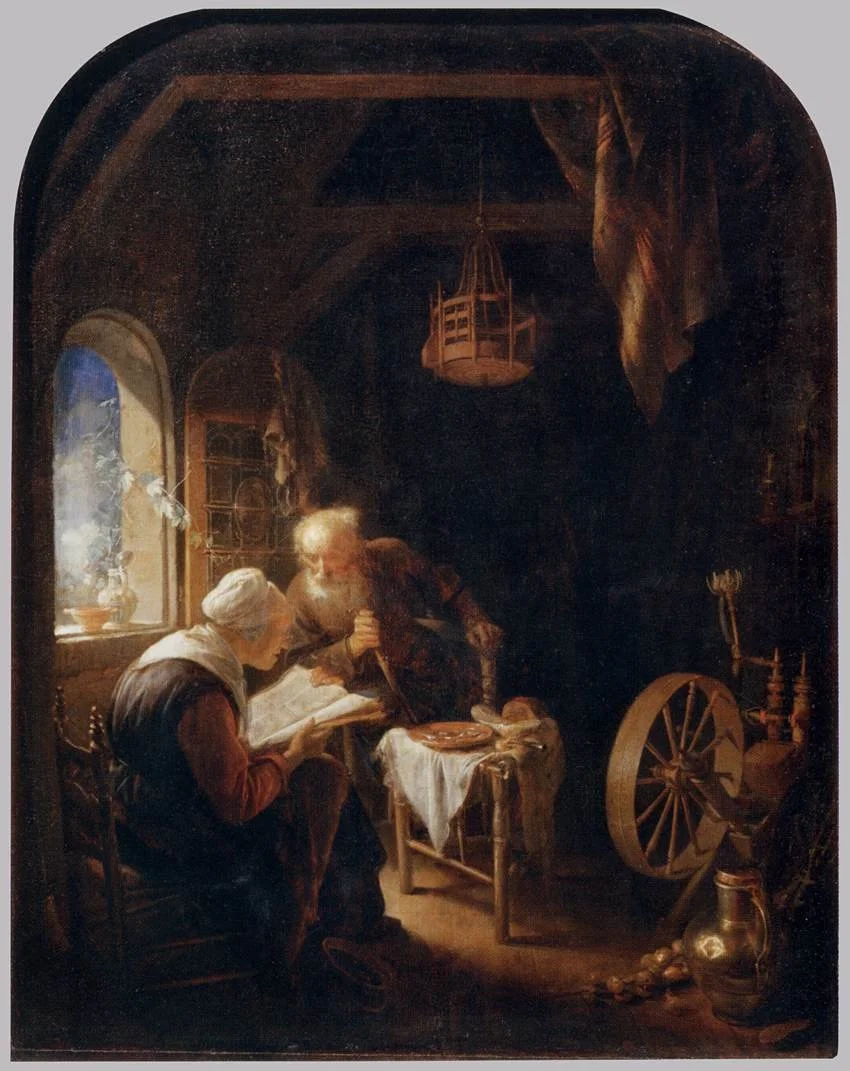
‘Reading the Bible’ (c. 1645), Gerrit Dou (1613–1675)
Oil on panel, the Louvre, Paris (courtesy Wikimedia)

Friends in Christ, habitually we have at least two Bible readings at church: one for the sermon series, the other mostly from the opposite Testament.
The non-sermon readings are designed to expose you to another part of God’s Word, in a systematic way.
It’s a bit like going to an art gallery to see a particular exhibition. That’s the Bible book for the sermon series. But on the way through the gallery you may also look at the paintings in another room, to get a wider sense of what’s going on in the world of art.
Currently most congregations have 1 Kings as the second, non-sermon reading. Sometimes those readings connect providentially with the featured sermon passage.
That’s not surprising since there is an overall consistency in God and his plans that unfolds through the sweep of biblical history. He is not caught off guard and jumping to Plan B or C! As my own personal Bible reading underlined this week, “No matter how many promises God has made, they are ‘Yes’ in Christ” (2 Corinthians 1:20).
God’s will – as an expression of his goodness and holiness – is consistent through Scripture. The Old Testament anticipates the coming of Jesus. The New Testament shows how Jesus fulfilled the Old. And of course, God does not revise or alter his morality.
There was a good illustration of this two weeks ago, when we read of God’s wisdom for the young from Titus 2:4-8. The qualities and example commended to younger women and men included kindness, self-control, doing good, seriousness and soundness of speech!
The Old Testament reading came from 1 Kings 12:1-15. It gave a contrasting illustration when a young king did the exact opposite. Rehoboam, who was to be crowned king of Israel, was responding to a request from the people to make their burdens lighter than his late father, King Solomon, did.
He takes advice from the elders who suggest giving a favourable answer. Instead he listens to the younger men, his peers. And they urge him to go harder and harsher.
This budding young king disrespects the voice of experience. Instead he promises to increase the burdens of his subjects and he speaks abusively to them.
He demonstrates no self-control, no kindness, no goodness and no seriousness or soundness of speech. And what happens to him is a warning for those who think Paul’s directions via Titus to the younger is merely a matter of opinion.
Then last week, we looked at the second half of 1 Kings 12, vv16-33. I saw no particular connection to the sermon passage.
But I did hear a challenge to the idea that you can think of God however you like to imagine him, or that you can worship God in a way that’s most convenient to you.
The rival king Jeroboam, who had taken over in the north of Israel, after they rejected Rehoboam’s abuse, decided it was too far to go to the Temple in Jerusalem. It would be more convenient to offer temple sacrifices locally… in territory he controlled. And he thought it was fine to set up gold statues of calves to represent the gods(!?!) who had rescued Israel from harsh slavery in Egypt.
This is the sin of idolatry, worshipping God in the way you prefer to think of him, in a manner convenient to you, and not as he has actually revealed himself. And it breaks the first and second commands! It’s no surprise that Jeroboam is assessed as one of the very worst kings of Israel, and becomes the chief example of idolatry through the rest of the books of Kings.
As I listened to that reading last week, I was reminded that my comfort or convenience should not the the deciding factor in where and when and how I worship God. Rather I should always be seeking first his righteousness and his kingdom, supremely as revealed in his Son, the risen Lord Jesus Christ.
Not what I feel like. But what Jesus wants. Lord, have mercy!
Warmly in Christ,
Sandy Grant
Dean of Sydney