Minister’s Letter – 6 August 2026
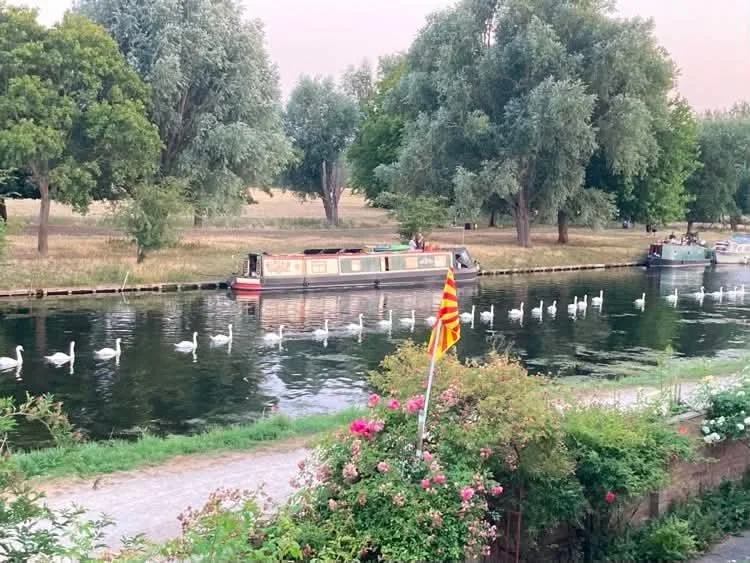
Swans on the River Cam, Cambridge, © Karyn Grant
Friends in Christ, Karyn and I were greatly blessed by 4 weeks’ annual leave, all of which we spent in England. Firstly we attended the English celebrations of our daughter’s earlier wedding in Australia. We could see how important our new son-in-law’s English family, friends, and home churches (in the south-west) were to him. Secondly, we had time travelling as a couple, visiting Cirencester, Cambridge and London.
Here are a few observations from out time away.
There is faithful gospel ministry going on in many churches that we were able to attend: Anglican, Baptist and Independent. Thank God for ministers and members humbly working away at sharing the Scriptures, loving their congregation, and honouring Jesus. Praise God for preserving his church in so many places, and for the gits he gives via the people he draws together in the body of Christ.
That said, there is a strong trend only to have one Bible reading in a service, and to hear very little other Scripture. I think this is a pity. (This included some evangelical Anglican churches.)
Even more seriously, it is possible to have the Bible read and referred to in a church service, but the gospel – of our Lord Jesus Christ and his cross and resurrections as the way of salvation – is entirely absent in a sermon. Some songs and hymns may be vague – merely to a generic God or Lord. And in one case, a detailed Old Testament sermon failed to lead to Christ in any way at all. It was all ‘example story’ and moralistic.
Secondly, the Christian passport is the best passport. In many case we felt an instant and immediate connection with Christians we met overseas. Our hosts in Exeter – our son-in-law’s old Bible study leaders – housed and fed us and our other two daughters, acted as a free Uber driver, included us in their family time, and encouraged us with great Christian conversations (and their enthusiasm for England in the World Cup)! All this, though they had never met us before.
At Cambridge, we just happened to sit down in front of an older lady who greeted us after church ended and turned out to be the daughter of the late Bishop Timothy Dudley Smith, whose hymns (like “Tell Out my Soul”) we enjoy at the Cathedral, and whose death we marked by a service which used his songs exclusively. We were delighted at how God arranged the seating plan for us as visitors that day.
On the other hand, there were a couple of times where even though we stood around after the service, smiling and looking for eye contact, where no one greeted us. Nothing occurred until we took the initiative. (In one case, Karyn ended up greeting another visitor who was on her own!) Sometimes regulars were busy greeting and encouraging others. But it is a reminder to look out for the visitor who obviously wants to connect. But if you are the visitor, we found it is almost always worth the extra effort to try and connect even when the locals are perhaps slow.
Thirdly, we were privlege to visit many wonderful and historic churches, including some Cathedrals. Perhaps understandably, but sadly, some of them charge entry-fees and we declined to go in to those ones. There were some wonderful displays and artefacts that testify to Christian belief, history and ministry. Some had volunteers who could sell you something in the cathedral shop or point out various bits of historic interest.
But as I said on Sunday last, in the places we visited, we experienced nothing like our own Cathedral’s Welcome and Evangelism team. I am so grateful to God for all who volunteer mid-week and on Sunday afternoons, ready to offer a listening ear, to answer questions, and alert to seize suitable changes to point people to Jesus, to encourage them to read the Bible, or to invite them back to a service or one of our other ministries. (And again, so encouraging to see this ministry featured in Southern Cross.)
In particular, it was a privilege to visit St Andrew’s Barnwell, whose building dates back to the 1100s (below at right). They donated their 1539 Great Bible for us to display in our Cathedral. I recorded a thank you video in the pulpit, midweek, in my holiday T-shirt, and you can view it and a couple of photos on the Cathedral Facebook page.
Lastly, we were able to view Roman ruins in Cirencester and London, and visit the various museums and galleries. We saw the fruits of archeological research and various historical artefacts. For example, the Cirencester ruins of the Roman amphitheatre, where games were held, makes Paul’s use of the image of the games and the arena, even more vivid. You really would have been a public spectacle in the arena, as he says in 1 Corinthians 4:19.
Likewise in the British Museum, I saw various coins minted by rulers of Judaea mentioned in the New Testament from the time of Christ (below at left). This included Herod the Great, his son Philip tetrarch of northern Judaea, a denarius with the image of Emperor Tiberius that Jesus used (Luke 20:20-26), and another minted by Roman prefect Pontius Pilate who sentenced Jesus to crucifixion! This does not prove the supernatural claims of the Bible. But it clearly demonstrates that the Bible is talking about historical people in real times and places with impressive accuracy. (Here is a fascinating recent article which explores this further.)
I am grateful for the provision of annual leave and the opportunity to travel.
Warmly in Christ
Sandy Grant
Dean of Sydney