The Names of God… And his Angel
Minister’s Letter – 11 June 2026
Dear Friends, here’s a short section on the names of God, that I won’t have time to include in my sermon on Sunday…
The names Jacob uses for God in Genesis 48 and 49 fill out our doctrine or teaching about God’s nature.
Of course, the way Jacob speaks of God does not list his attributes dictionary style: A for almighty,
E for ever-present,
O for omniscient.
Rather Jacob talks of God relationally. He recalls the way God has related to him. Chapter 48:15 says
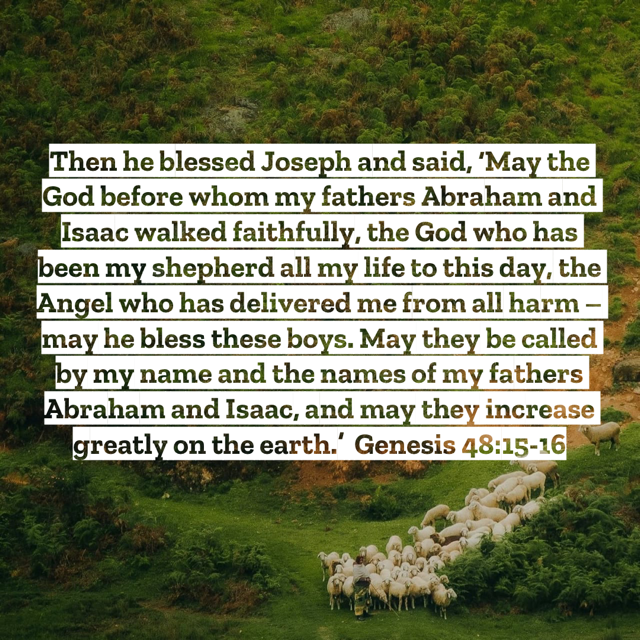
Then [Jacob] blessed Joseph and said,‘May the God before whom my fathers
Abraham and Isaac walked faithfully,
the God who has been my shepherd
all my life to this day…’
From v15, God is the God Jacob’s ancestors walked before – a reminder of his faithfulness.
And he’s the God who’s been his shepherd… A vivid image when you remember Jacob’s own profession. That’s how he won his wives and built his wealth as a young man – shepherding the flocks.
And that tender care and protection – I think of my parents-in-laws bottle feeding orphaned lambs, as well as shooting predatory foxes – that’s how Jacob perceived God.
Notice how Jacob also addresses this same God in v16, as “the Angel who has delivered me from all harm”.
Genesis records a number of times when an angel visits the patriarchs, typically at moments of personal crisis. And often the text switches interchangeably between referring to the LORD and the angel of the LORD.
For example, Gen 31:11 says the angel of God spoke to Jacob. But 31:13 then records the angel as saying, “I am the God of Bethel… where you made a vow”. Not “I am the angel of God”, but simply “I am God”.
Why do I draw your attention to this?
Because these passages contain hints of plurality within God.
The angel appears like a glorious man, but is simultaneously equated with God.
The Old Testament insists on monotheism: “the Lord our God, the Lord is one” (Deuteronomy 6:4).
Yet, here, the Angel of the Lord is a figure who is identified with God, yet is distinct from him. At this point of the Bible, there’s no explanation of how it can be.
But it forms an intriguing background to the coming of Christ and the gift of his Spirit in the New Testament. Here we see that the one true God exists in three equal persons – Father, Son and Holy Spirit… Three-in-one… Tri-unity… Trinity!
Warmly in Christ,
Sandy Grant
Dean of Sydney
P.S. You might like to watch this short video where our Archbishop encourages you to pray for Parish Leadership. I am grateful for this encouragement and your prayers.