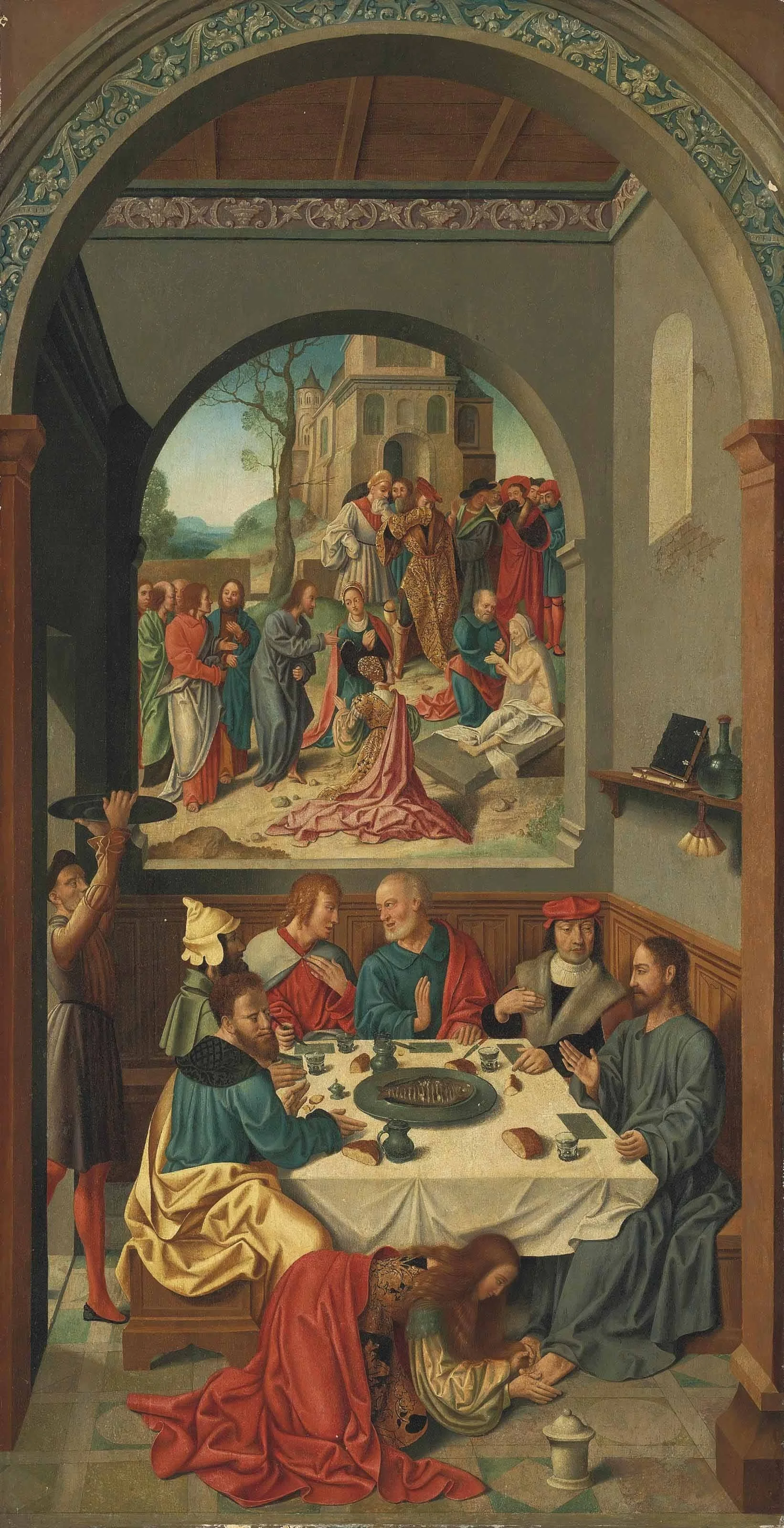
Mary Anoints Jesus' Feet – anonymous (German school, 16th cent.), courtesy Wikimedia Commons

Minister’s letter – 12 November 2026
Friends in Christ, in one of his books, Mack Stiles relates a conversation where a friend says,
“Of course, I believe in the resurrection, but let’s not get carried away.”
What about you? Are you a ‘don’t-go-overboard’ Christian?
It fits the Australian approach to life. We tend to be laid back. We don’t like fanatics. Some of us go to church, give our offertory, say grace, read our Bibles, help in some ministry. But it’s balanced with other stuff: family, work, hobbies.
“Don’t get carried away” is the polar opposite of the woman we meet in John 12:3…
Mary took about half a litre of pure nard, an expensive perfume; she poured it on Jesus’ feet and wiped his feet with her hair. And the house was filled with the fragrance of the perfume.
The perfume is not the highly concentrated extract we see in tiny bottles, where you only use a few drops of Chanel. Rather it was more like a body lotion. This one was made from oil extracted from a plant imported from India – expensive by purity, quantity and origin!
Mary’s expensive gift shows how much she values Jesus. And attending to feet dirty from the dusty road is a servant’s job. But Mary does it willingly. She did not care about the cost. She did not worry about what people thought of her.
It expresses how great she thinks Jesus is. And little wonder. She’d seen Jesus conquer the grave and restore her brother, Lazarus to life. So she offers no casual compliment but full-blooded adoration.
And it’s more important even than helping the poor. Look at verses 4-5.
But one of his disciples, Judas Iscariot, who was later to betray him, objected, ‘Why wasn’t this perfume sold and the money given to the poor? It was worth a year’s wages.’
In today’s language I guess that’s almost $100,000. Wasn’t this a waste? But in v6, John says there was more to Judas’s objection than met the eye: Judas turned out to be a thief.
Now when Jesus says the poor will always be around (v8), he’s actually referencing the Old Testament, in a section that went on to command generosity to the poor.
Jesus can scarcely be denying that command. That would contradict the rest of the Bible. Yet we must not water down v8! “But you will not always have me”, says Jesus.
Jesus is either suffering the delusions of grandeur – or he is the most important person of history! Can you imagine the Dalai Lama saying such things? If Jesus is not the unique Son of God, then he’s a crazy egomaniac. Either way, you cannot put him in the box of nice religious teacher who just says be kind to the poor.
V7 explains it for us, when Jesus says that whether she knew it or not, Mary was preparing for his burial. The funeral customs of his day included the pricey perfume needed to stifle the stink of decomposition.
So Jesus says Mary’s lotion has anticipated his death. At the time, none of his disciples understood his predictions that he was soon to die. But looking back later. John connects it to the Passover context (v1).
The Passover reminded Israel that they’d been rescued from slavery in Egypt. And it happened by sacrifice. The blood of the Passover lamb was put on the doorframe of your house. And those under the blood were kept safe. Now John sees that by timing Jesus’ death to the Passover, God is presenting Jesus’ blood as the perfect sacrifice for the sins of the world.
To put it another way, Jesus can conquer the grave as he did for Lazarus, because he went to grave himself, bearing our sins on the cross.
Jesus says that Mary’s devotion is a most apt preparation for his coming death. His sacrifice is far more valuable than a year’s wages. Why? Because the cross brings forgiveness of sins.
Don’t mistake social justice for the worship of Jesus. Helping the poor is good, but it’s not the gospel. Atheists can do that too.
Believing in Jesus is what counts. Worshipping him!
In your balanced Christianity, can you imagine blowing a year’s wages in one, all-out effort to honour Jesus?
Mary could. Her example asks: How could you not get carried away by what Jesus has done for us?
Warmly in Christ,
Sandy Grant
Dean of Sydney
P.S. My sermon for Remembrance Sunday – “Just War in an AI Era” – was deeply informed by the Sydney Anglicans Social Issues Committee briefing which I link here, entitled “The Just War Tradition in a Conflicted World”.
Our previous briefing also explored AI, with a focus on Christian ministry in its conclusions: Christian Ministry, Ethics and Artificial Intelligence.
Perhaps the best thing I have read on AI more broadly comes from The Gospel Coalition and was based on applying the Ten Commands: “10 Resolutions for AI Use”.