Minister’s letter – 19 November 2026
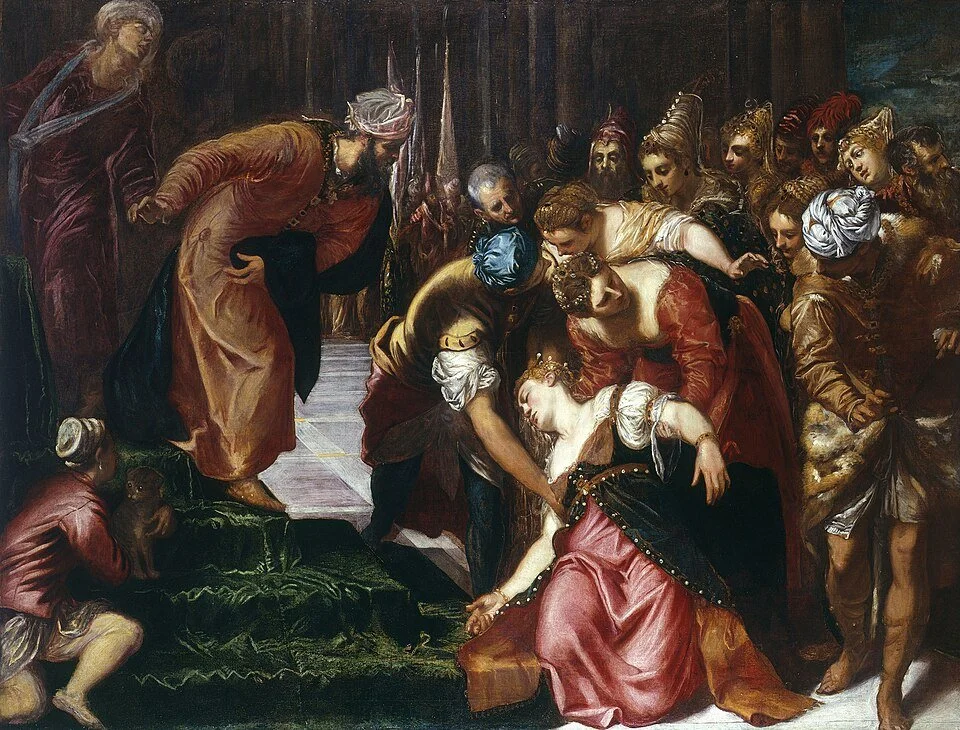
Esther Before Ahasuerus – Tintoretto, c.1546–47, Kensington Palace, London, image courtesy Wikimedia Commons
Friends in Christ, freedom of religion is a massive topic in our world. It goes with freedoms of speech, association and conscience. But some would prefer freedom from religion. …Especially freedom from your particular religion! And others think it means freedom from criticism of their religion. Not so!
In the Old Testament book of Esther, chapter 7 is perhaps the book’s climax. The narrative is set in King Xerxes’ court (a.k.a. Ahasuerus), in the heart of the ancient Persian Empire. And we get something of a lesson in freedom of religion.
You’ll recall that Esther, a pretty young Jewish girl, has won, by the providence of God, not only a beauty contest, but the heart of King Xerxes. However, then as now, it wasn’t always plain sailing being Jewish. So Esther was urged by her uncle to hide her ethnic background. Haman, a high-powered royal official hated the Jews and advised King Xerxes not to tolerate the Jews and their distinctive religious practices. Instead he convinced the King to destroy them as subversives.
We’re not talking about a democracy that respects human rights here!
Her uncle advises Queen Esther that she won’t escape just because she is in the palace, and ask her to approach the King to plead for mercy. So she asks all the Jews to fast, which presumably also includes praying.
And then she courageously approaches the King, which she wasn’t allowed to do without permission, and puts her plan into practice.
Here in chapter 7, she reveals herself as Jew. She belongs to the people v4 says had been “sold to be destroyed, killed and annihilated”.
She pleads for her own life and for the life of her threatened Jewish brothers and sisters.
And the King grants her petition.
He now sees Haman’s request had not been just a matter of pacifying political opponents, but a murderous plot. Clearly he sees Esther as a precious person. And I guess he remembers that Mordecai, who’d saved him from assassination, was Esther’s uncle, and therefore also Jewish.
He realises you can’t just write people off because of their religion or ethnicity. By the way, you can understand why this Old Testament book is so precious to a people who have endured the Holocaust.
There’s more to come in that book of Esther… You see the judgment fall on Haman because of his own disregard for human rights. And later, there are big questions of “When does self-defence turn into revenge?”
But todayt, I want to reflect with you on religious freedom.
Some warn against the idea of asking the Government for “freedom for faith”. We already have ultimate freedom in Jesus.
Esther interceded for her people with the King, at threat to her life. But we have the Lord Jesus who interceded with God, for the life of sinners like you and me, at the price of his life on the cross.
And if we do suffer for being a Christian, then 1 Peter 4 says we can praise God. We should make sure the government discriminates against you, not because of your bad behaviour, but because you bear that name ‘Christian’.
And remember, you are free before God, and your future is sure. By faith in Jesus, you are numbered among the saved. And you will be overjoyed when Jesus’ glory is finally revealed.
So we don’t need to beg the government for anything. But it’s not an either/or thing.
The Jewish people people fasted; Esther committed herself to her faithful Creator. But she also asked the pagan King for mercy; she asked for her people’s freedom.
And she showed great courage in doing so, for she did not live in a land of democracy.
Likewise, when Paul and Silas were unjustly jailed in Philippi for preaching the gospel, they sang hymns of praise in prison, and committed themselves to God.
But when they were miraculously freed, and the government authorities just wanted to get them out of town, Paul insisted on a public apology first, because they had failed to respect his rights as Roman citizens. (You can see it all at the end of Acts 16).
I don’t think Paul appealed to his citizenship rights because he was proud or afraid, but because he wanted to establish the legitimate place of the Christian religion in the Roman Empire. He wanted to make it easier for the Christians left behind in that town after he left.
So we pray, and obey God regardless. But under his sovereignty we can also advocate for religious freedom.
Warmly in Christ,
Sandy Grant
Dean of Sydney
P.S. Poker machine reform is back in the news (see my Facebook post), and it’s only a few months before the next State election. If you want to email your local state MP and ask them to take action, then the easiest way is to use Wesley Mission's automated tool (albeit you can personalise the message).